LISTENER
Keep track of who is speaking.
Treat voice differentiation as a comprehension question to explore.
SpotifyWorking prototype
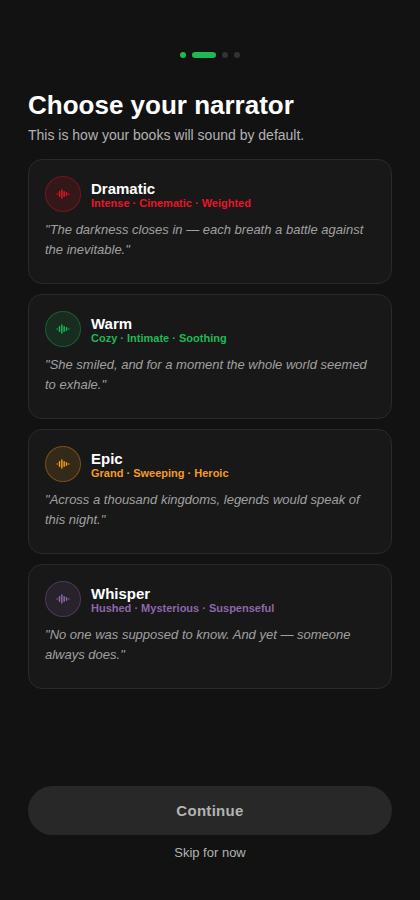
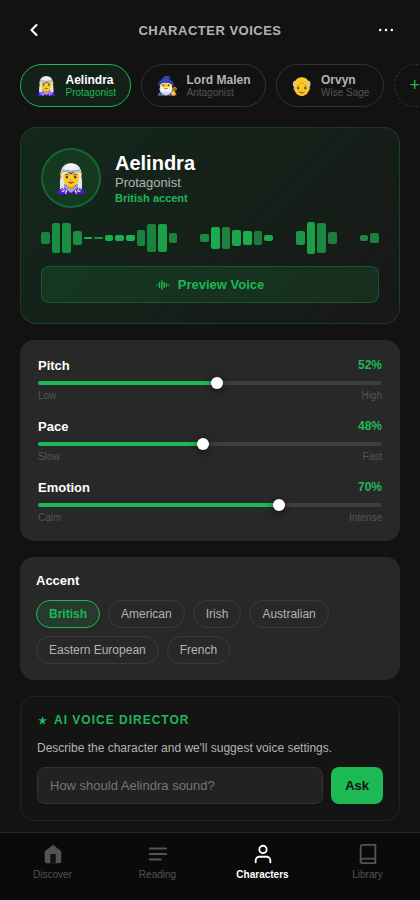
A working LLM prototype explored narrator selection, character voices, and word synchronization. I cut directions that risked changing the author’s intent.
Context
I was hired to explore how LLM-driven interaction models could reshape listening. An audiobook experiment took that question from problem framing to a working prototype.
The design problem was helping listeners distinguish characters in complex narratives while preserving a familiar listening experience. Voice technology had to serve that purpose.
LISTENER
Treat voice differentiation as a comprehension question to explore.
PRODUCT
Introduce new capabilities without turning the player into an AI control panel.
SCOPE
Build an interaction model that could be experienced and discussed.
Insight
Pitch, pace, emotion, and character voices could vary. The author’s words and the sequence of the narrative formed the boundary of the experiment.
I treated character differentiation as a potential aid to comprehension. The design thesis needed a working interaction model before any claim about listener benefit.
VARIABLE
Narrator style, per-character voices, and delivery controls.
FIXED
Preserve authored content and sequential narrative.
EXPERIENCE
Listeners choose the controls they need; the story remains central.
Decisions
Mood-adaptive narration was cut to keep the story in charge. AI chapter summaries were cut to respect the author’s intent. The player stayed free of proactive AI suggestions.
The proposed story companion was passive: aware of the book and the listener’s position, but waiting to be asked. Narrator and character controls made the voice exploration concrete.
SERVE THE STORY
Avoid making the listener’s mood override the story’s delivery.
RESPECT THE AUTHOR
Keep the authored narrative intact.
DISCOVERABLE BY CHOICE
Keep proactive AI suggestions out of the player.
Impact
Narrator style selection, per-character voices, and word-by-word synchronization were implemented in a live prototype.
The contribution was a demonstrable interaction model and a decision framework for AI in storytelling. The prototype made the boundaries as visible as the capabilities.
What changed, and where
The prototype demonstrated an interaction model and made the consequences of product principles visible.
Listening experience
Working prototype
Product decisions
Decisions applied to scope
Discovery
Demonstrated interaction model
Listener comprehension, production performance, and commercial outcomes still need validation. The prototype does not establish organization-wide adoption of the framework.